


Ontario Auto Reform 2026: Broker Support & Client Resources
A QuickFacts perspective on Ontario’s auto reform 2026 and what it actually means for brokers.
Nobody got into this business expecting to re-explain the entire accident benefits framework to their book of business at the same time.
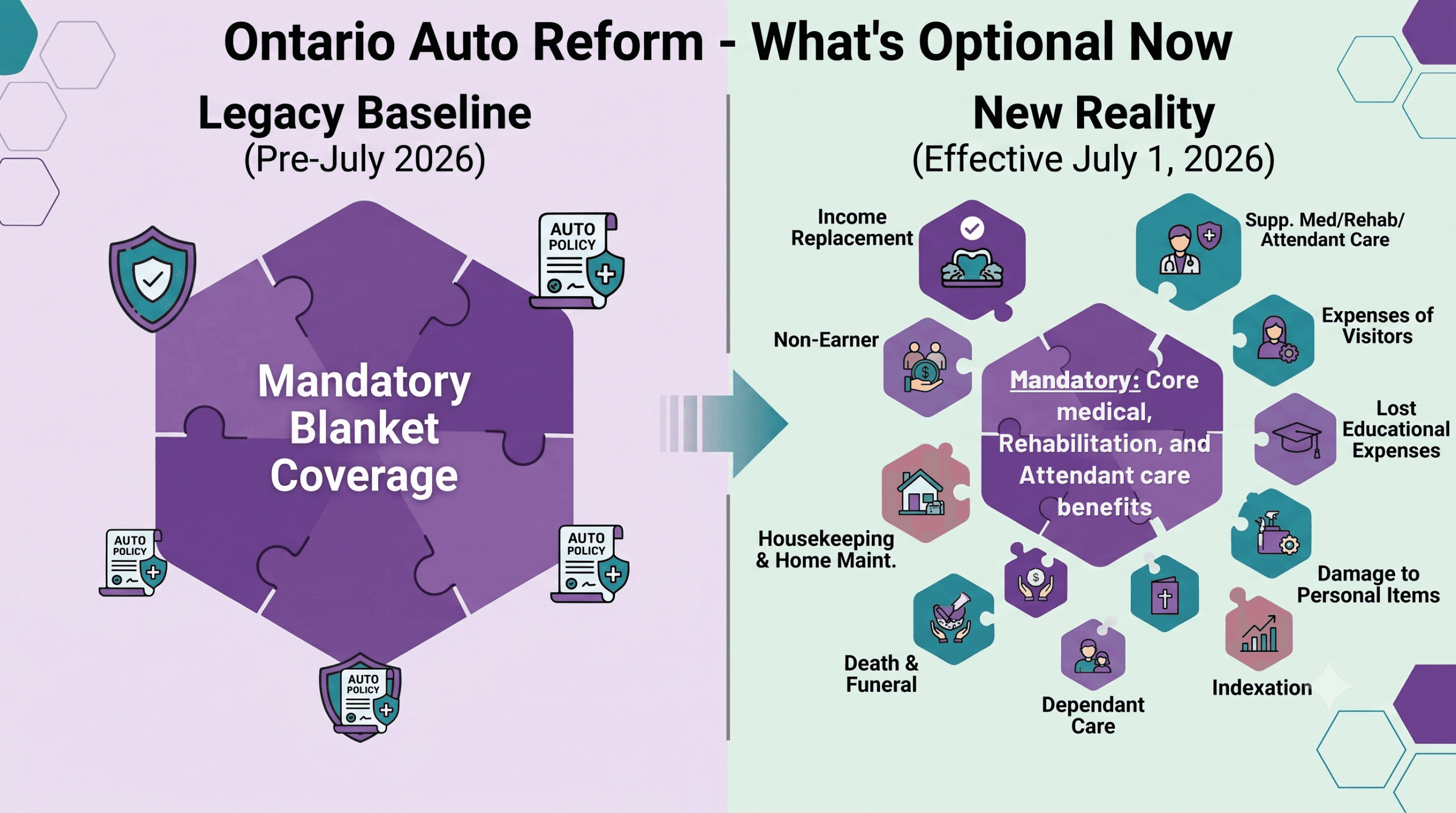
Ontario’s Statutory Accident Benefits are undergoing their most significant structural change in years. Nine benefits that have long been a standard part of every auto policy, benefits your clients have been paying for, often without much thought, are becoming optional. They no longer apply automatically. Clients must actively choose to keep them.
That is not a minor administrative change. It is a fundamental shift in how auto coverage works in Ontario, and brokers are managing it across their entire book simultaneously. This leads to questions like “How does Ontario auto reform affect my renewal?” or “Do I need optional accident benefits if I have workplace benefits?”
We have been watching this reform closely. Here is our honest read of it.
What Changed on July 1, 2026?
As of July 1, the following benefits shift from automatic inclusion to optional purchase:
- Income Replacement Benefit
- Non-Earner Benefit
- Caregiver Benefit
- Housekeeping and Home Maintenance Benefit
- Lost Educational Expenses
- Expenses of Visitors
- Damage to Personal Items (glasses, hearing aids, etc.)
- Death Benefits
- Funeral Benefits
Core medical, rehabilitation, and attendant care benefits remain mandatory. Everything else requires a decision.
That list is longer than most clients will expect, and several items on it carry real financial consequences. A client who waives income replacement and non-earner benefits, for example, may not realize they’ve also made a decision about caregiver and death benefits by default. Each one is a separate conversation, and the documentation burden compounds quickly.
The Passenger Gap: Who Is (and Isn’t) Covered Under Optional Benefits
Here is the part of this reform that tends to get less airtime, and it is arguably the most operationally relevant.
Under the new framework, optional benefits only apply to the named insured, their spouse, their dependants, and listed drivers. Passengers who are not listed on the policy, a neighbour catching a ride, a friend in the back seat, anyone who is not the named insured or a listed driver, cannot access those optional benefits under someone else’s policy.
They still have access to mandatory medical, rehab, and attendant care. But if a client’s passenger is off work for six months and there is no income replacement available under the policy, that gap falls to their own auto coverage (if they have it), the tort system, or nothing at all.
Based on how the eligibility rules are structured, we expect questions to arise about dependent status, particularly in situations where an injured party was present in a vehicle but not listed on the policy. The reform was designed to give consumers more choice and flexibility. Whether it reduces or redirects legal complexity over time remains to be seen, but the eligibility boundaries introduced by optionality create new scenarios that brokers, clients, and the legal system will need to work through.
None of this is an argument against optionality. It is an argument for making sure brokers and their clients genuinely understand what they are choosing, and what they are giving up.
Our Read: A Policy Shift Wearing a Systems Problem
What concerns us most is not the policy design. It is the ground-level reality brokers are navigating right now.
Every broker in Ontario is responsible for communicating these changes to their full book, not just renewers, but every active client. These are not renewal conversations that follow a familiar script. They are nuanced coverage discussions with clients who have never once thought about whether their auto policy includes a housekeeping benefit. Every one of those conversations needs to be documented for Error & Omissions (E&O) purposes. Senior clients, students, homemakers, self-employed individuals, and contractors all carry elevated exposure under the new framework, and they need to be identified and prioritized.
Registered Insurance Brokers of Ontario (RIBO) has been explicit on this point: the renewal package alone is not sufficient. The advice obligation belongs to the broker.
Add to that the operational complexity of comparing carrier-specific limits for newly optional benefits across your panel, while those limits are still being filed, and you have a meaningful workload increase with a hard deadline attached.

The Reality of Retention Under Ontario Auto Reform
We have been listening to the community, and a consistent theme has emerged from the front lines: the Ontario Auto Reform has fundamentally transformed the renewal process.
Renewals are already a substantial load on brokers, especially if remarketing is involved. Now, brokers need to spend even more time ensuring there are no coverage gaps for the customer and no E&O risks for the broker. This operational shift isn’t a lack of efficiency; it is a requirement for thorough diligence. Because vital protections (like Income Replacement and Caregiver benefits) are now fully optional, brokers must:
- Navigate all 9 Statutory Accident Benefits Schedule (SABS) options to ensure clients understand the severe liability gaps of opting out.
- Meticulously document every declined coverage to protect the brokerage against rising E&O risks.
Retention is no longer just about keeping a client on the books; it is about steering them safely through a complex regulatory landscape.
The Information Exists. It Is Just Scattered
RIBO has published guidance. Insurance Brokers Association of Ontario (IBAO) has built training material. Financial Services Regulatory Authority of Ontario (FSRA) has updated forms. Insurance Bureau of Canada (IBC) has consumer FAQs. Your carriers are updating their portals.
That is a lot of useful material spread across a lot of places.
A broker trying to understand how Carrier X defines the caregiver benefit limit compared to Carrier Y, while also factoring in a client with a commercial policy and a student driver in the household, is not going to find that comparison in one place. They are going to open several tabs, read PDFs, and likely call a carrier rep and wait for a callback. That is not a broker problem. That is a systems problem. The information is there, but it is fragmented in a way that slows you down at exactly the moment you need speed.
How QuickFacts Approaches This
We built our comparison so brokers are not piecing this together from six different sources under deadline pressure. Benefit status, carrier comparisons, eligibility edge cases, coverage gap profiles, client conversation frameworks, and E&O documentation, in one place, updated as carriers file.
- Powerful Keyword Search: Type “auto reform” to instantly pull up everything you need in one click.
- Side-by-Side Comparisons: Compare carrier-specific mandatory benefits, optional choices, limits, and eligibility rules without the manual labour.
- Real-Time Carrier Updates: Our agile team updates carrier changes, bulletins, and job aids the moment they unfold.
- Official Educational Resources: Access a one-stop hub for official guides from organizations like the IBAO, FSRA, and IBC.
The advice obligation is yours. The information burden does not have to be.
Book a Demo to learn more.